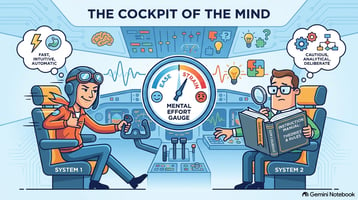
We Welcome You to the Beginning of our Blog on Life, Marketing and Influence.
Have you ever driven down a familiar, empty road and realized upon arriving at your destination that you don't remember the actual trip? Or perhaps you instantly knew the answer to 2+2 without having to consciously calculate it? That is your brain's fast-thinking system seamlessly at work.
In his groundbreaking book Thinking, Fast and Slow, Nobel laureate Daniel Kahneman explains that our minds operate using two distinct cognitive subsystems. Understanding how these two systems function, how they interact, and where they falter is the absolute foundation for recognizing how we make daily choices, how we experience psychological stress, and how we are ultimately persuaded by the world around us.
System 1: The Intuitive Autopilot
System 1 is our brain's fast, automatic, intuitive, emotional, and unconscious mode of processing. It acts as our mental autopilot and handles the vast majority of our daily decisions because the human brain instinctively prioritizes conserving its finite cognitive energy. To operate at such incredible speeds, System 1 relies heavily on mental shortcuts—known as heuristics—to respond to our environment.
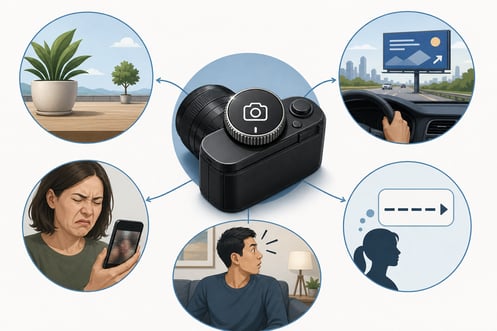
You can think of System 1 as a camera's automatic "point-and-shoot" mode, efficiently guiding your immediate, default reactions without requiring you to manually adjust the settings. Examples of System 1 in action include:
- Determining that one object is physically further away than another.
- Effortlessly reading the text on a large billboard as you drive past.
- Instantly displaying a facial expression of disgust when seeing a gruesome image.
- Localizing the source of a sudden, loud sound in a room.
- Completing a highly familiar phrase, such as "war and...".
 System 1 is an evolutionary marvel designed to keep us alive. It constantly scans our environment, assesses threats, and makes split-second value judgments. However, because it relies on these rapid shortcuts and past associations, it is highly prone to cognitive biases and errors when faced with modern, complex problems.
System 2: The Analytical Controller
System 2, on the other hand, is our slow, effortful, logical, calculating, and conscious mode of thinking. It requires deliberate focus, sustained attention, and a significant amount of cognitive energy to operate. If System 1 is the automatic point-and-shoot camera, System 2 is the manual mode, giving you the flexibility to override automatic settings to carefully navigate a novel or complex situation.
We must actively engage System 2 for tasks that require our full, undivided attention. Examples of System 2 in action include:
- Solving a complex mathematical problem, such as calculating 17 x 24 in your head.
- Parking a large vehicle into a very tight parking space.
- Sustaining a faster-than-normal walking rate.
- Determining the precise price-to-quality ratio of two competing washing machines.
- Evaluating the validity of a complex logical argument.
While System 2 is highly analytical and capable of profound reasoning, it is also inherently lazy. Because active thinking consumes an enormous amount of our finite energy and willpower, System 2 is usually happy to sit back and simply accept the intuitive suggestions offered by System 1.
The Dance Between the Two Systems: Where We Make Mistakes
We live most of our lives on automatic pilot, relying heavily on System 1. However, System 1 and System 2 constantly interact, which dictates our behavior and can lead to fascinating cognitive errors when System 1 jumps to a conclusion and System 2 fails to correct it.
To understand how these systems can conflict, consider the famous Bat and Ball Problem. Imagine you are told that a baseball bat and a ball cost $1.10 in total, and the bat costs exactly $1.00 more than the ball. How much does the ball cost?
For most people, System1 quickly, confidently, and intuitively yells "$0.10!".
It takes the slower, analytical System 2 to pause the impulse, actually perform the calculation, and realize the correct answer is $0.05 (If the ball is $0.05, the bat is $1.05, totaling $1.10). System 1 automatically substituted a difficult math calculation for an easier, intuitive guess. 
Another powerful example is The Linda Problem (Conjunction Fallacy). Imagine being told a story about a woman named Linda who is young, single, outspoken, and highly intelligent. You learn that she majored in philosophy and, as a student, was deeply concerned with issues of discrimination and social justice. If you are then asked whether it is mathematically more probable that Linda is currently a "bank teller" or a "bank teller and an active feminist," your fast-thinking System 1 will likely jump to the latter.
In psychological experiments, an overwhelming majority of people choose the second option, violating the basic laws of probability. Logically, every feminist bank teller is also a bank teller, so the first option must inherently be more statistically probable. This cognitive error occurs because System 1 automatically substitutes a difficult probability calculation for an easier question: "Does Linda fit the stereotype of a feminist?". System 2 often fails to step in and correct this statistical impossibility.
We also see this interaction in Attention and Social Norms. System 1 effortlessly handles passive tasks like reading a billboard or recognizing a friend's face. However, it falls entirely short when a situation requires deliberate focus. If you need to actively scan a chaotic, loud party for a specific person, or deliberately monitor your own behavior to ensure it is appropriate in a complex social setting, you must expend the energy to activate System 2.
The Energetic Cost of Thinking
To truly grasp the intersection of living and persuasion, we must understand the energetic cost of engaging System 2. The act of active thinking—engaging with the thoughts in your mind to analyze, worry, or calculate—requires a colossal amount of energy and effort. Willpower and cognitive capacity are finite resources. 
When we spend the majority of our day in a state of stressful overthinking, we drain this energy. This is why, after a long day of making difficult analytical decisions at work, you might find yourself unable to resist eating junk food or snapping at a loved one; your System 2 is exhausted, and your impulsive System 1 has completely taken over the steering wheel. Understanding this dynamic is crucial for marketers and persuaders. Marketers know that if they can reduce the cognitive load required to understand a product, they can bypass the critical System 2 and speak directly to the impulsive System 1.
The Evolution of Science: A Note on the Replication Crisis
While the dual-process framework of System 1 and System 2 is a massive pillar of modern behavioral economics, it is also important to note that the scientific process is always evolving. In recent years, psychology has undergone a "replication crisis," where researchers have found it difficult to reproduce the results of several classic studies.
Specifically, parts of Chapter 4 in Kahneman's book, which dealt with "priming" (the idea that subtle environmental cues can drastically and unconsciously alter behavior), relied on studies that were later found to be statistically underpowered. Kahneman himself, demonstrating remarkable intellectual humility, publicly acknowledged this. He wrote a detailed response stating, "I placed too much faith in underpowered studies," and noted the irony that his early career was built on proving why researchers shouldn't trust studies with unreasonably small samples.
Despite these specific methodological critiques regarding priming, the overarching paradigm of fast and slow thinking, and the existence of cognitive biases like anchoring and confirmation bias, remain robust, highly influential, and central to our understanding of human behavior.
Conclusion: Applying Fast and Slow Thinking
Recognizing which system is driving a decision is the very first step in understanding how we navigate our daily lives and how businesses apply marketing to influence us. By recognizing when a quick decision is being driven by the heuristics of System 1, we can intentionally slow down, take a breath, and engage System 2 to evaluate the information critically.
In the realm of persuasion, the goal is often to induce "cognitive ease" so that the audience's System 1 feels safe and familiar, preventing their skeptical System 2 from raising objections. As we continue our journey through this blog, we will explore exactly how these mental shortcuts manifest as specific biases.
References:
- Kahneman, D. Thinking, Fast and Slow.
- Model Thinkers. Fast and Slow Thinking.
- Nguyen, J. Don't Believe Everything You Think.
- Dual process theory (moral psychology).
- Retraction Watch. “I placed too much faith in underpowered studies:” Nobel Prize winner admits mistakes.