For decades, marketing agencies built their business models on a straightforward premise: labor equals value.
If a client needed a blog post, a social campaign, custom graphic design, or automated email flows, they hired an agency because the client simply lacked the hours, specialized software, or in-house talent to produce it.
AI has obliterated that model.
Today, anyone can generate polished graphics and functional copy in a matter of minutes for next to nothing. Clients know it, agency founders know it, and the marketplace has already begun recalibrating what it is willing to pay for basic content production.
So what happens to the agency when AI does the heavy lifting?
In my recent interview on Agency Visionaries with Hannah Kenerly, we broke down why the commoditization of content isn’t the death of the agency—it is the catalyst for agencies to finally step into their true, highest-value role: strategic context architects, diagnostic problem solvers, and behavioral navigators.
1. From "Content Factories" to Context Stewards
If your agency relies solely on selling billable hours for raw content creation, you are competing against a machine that works for pennies. But there is a glaring flaw in raw AI output: it cannot be trusted in a vacuum. AI can't be trusted alone. Everything must be reviewed by a human eye, and the prompts to create meaningful content must be driven by human strategy."
The real differentiator in modern marketing isn't the ability to generate words—it’s Context.
HubSpot co-founder Dharmesh Shah recently highlighted a critical evolution in how we evaluate intelligence: beyond IQ (Intelligence Quotient) and EQ (Emotional Quotient), what now dictates marketing success is CQ—Context Quotient.
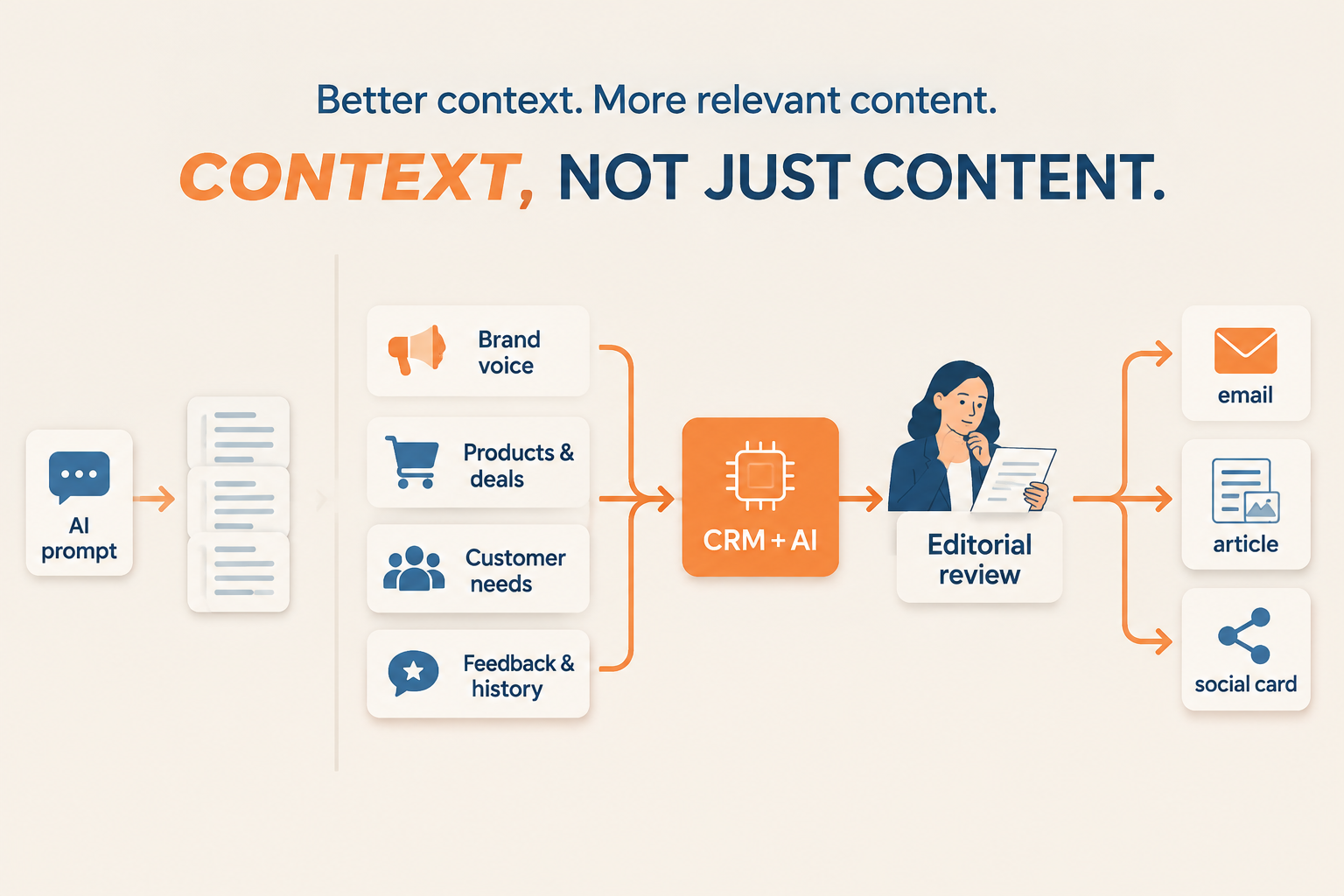
Generic prompts fed into standalone AI chatbots produce generic, tone-deaf copy because the tool knows nothing about your company. In contrast, an AI engine integrated directly into your CRM (like Hubspot's CRM) understands:
-
-
Your exact value proposition and brand voice.
- The specific products and service tiers within your active deals.
-
Your current prospects, their industry verticals, and deal sizes.
-
Real customer feedback and behavioral interaction history.
When AI possesses rich internal context, it stops outputting generic "marketing slop" and begins delivering high-precision campaign collateral. The agency’s job is no longer writing every syllable from scratch; our job is curating that context, defining the competitive parameters, and providing the editorial oversight that keeps a brand human.
2. AEO vs. SEO: The Reality of Modern Search
A major point of anxiety in marketing circles today is AEO (Answer Engine Optimization)—optimizing to be cited inside AI search engines like ChatGPT, Perplexity, Gemini and Claude.
As long time SEO expert Rand Fishkin (founder of Moz and SparkToro) often points out: AEO is simply SEO in a new outfit. While AI answer engines are undeniably growing, it’s vital to keep the numbers in perspective:
- Alternative AI engines (as of today) handle roughly 400,000 searches per day.
- Google still processes over 6 billion searches per day.
We cannot afford to ignore Google while chasing shiny objects. Modern search intelligence tools (like HubSpot’s built-in AEO module) evaluate your web footprint, identify the exact queries you are missing across both traditional search and AI models (Claude, Gemini, OpenAI, Perplexity), and generate prescriptive content recommendations to close those visibility gaps.
The strategy is not abandoning proven SEO fundamentals; it is maintaining multi-channel visibility so your brand appears wherever the customer chooses to look.
3. The "100% Rule" of Client Discovery: Treating the Fracture, Not the Bruise
During our conversation, Hannah asked me a question every consultant wrestles with:
"How often do clients come to you thinking their problem is one thing, and after talking to them, you discover it’s something completely different?"
My answer: Usually about 100% of the time.
Clients almost universally arrive with end-user surface symptoms:
- "Our sales are down."
- "Our data reporting is broken."
- "We need more TikTok ads and better SEO."
These are useful starting points. They are not yet a diagnosis.
Consider this hypothetical example. A company reports an unreliable pipeline forecast. After reviewing the process with the sales team, you discover that updating records requires duplicate entry and that important notes are often missing.
More reporting will not correct missing information. The first step is to understand the recording process, remove unnecessary work, and establish responsibility for data quality. Automation may help, but it should be tested for accuracy and usefulness rather than assumed to solve the problem.
The same discipline applies to content. Weak campaign performance might reflect an unclear offer, the wrong audience, inconsistent messaging, insufficient distribution, or something else entirely. Publishing more posts before investigating can repeat the same mistake at greater volume.
We believe that prognosis without proper diagnosis is malpractice.
4. Beware the "Frankenstein" Tech Stack
Over my 30 years in digital marketing—and 14 years as a HubSpot Solutions Partner—I’ve watched enterprise platforms attempt to solve their growth bottlenecks through frantic acquisitions.
A legacy CRM provider realizes they lack email marketing, so they buy an external marketing vendor. Later, they acquire a standalone ticketing tool. They slap their logo on all three, stitch them together behind the scenes, and hand the client a "Frankenstein system."
The result? Data silos, broken syncs, and sales teams that cannot see what marketing or customer service is doing.
Real marketing agility requires a single, unified database. When your CRM, marketing automation, service hub, and content engines share the exact same contact record:
- Sales reps can see every page, email, and resource a prospect engaged with before picking up the phone.
- Support teams know the exact deal terms and customer sentiment before answering a ticket.
- Marketers can attribute revenue directly to specific campaigns without exporting conflicting spreadsheets.
5. The Deeper Game: Changing Your Algorithm
Technology, CRMs, and AI are merely execution tools. The true foundation of marketing and human decision-making lies in applied behavioral science.
For over 11 years, I have taught digital marketing at the UCLA Extension program. On day one, I tell my students:
"Setting up a pay-per-click campaign or publishing a blog post is the easy mechanical part. The real work of marketing is understanding the unconscious psychological principles that govern human assent."
This is the central theme of my upcoming book, Change Your Algorithm: How to See the Triggers, Interrupt the Program, and Reclaim Your Choices
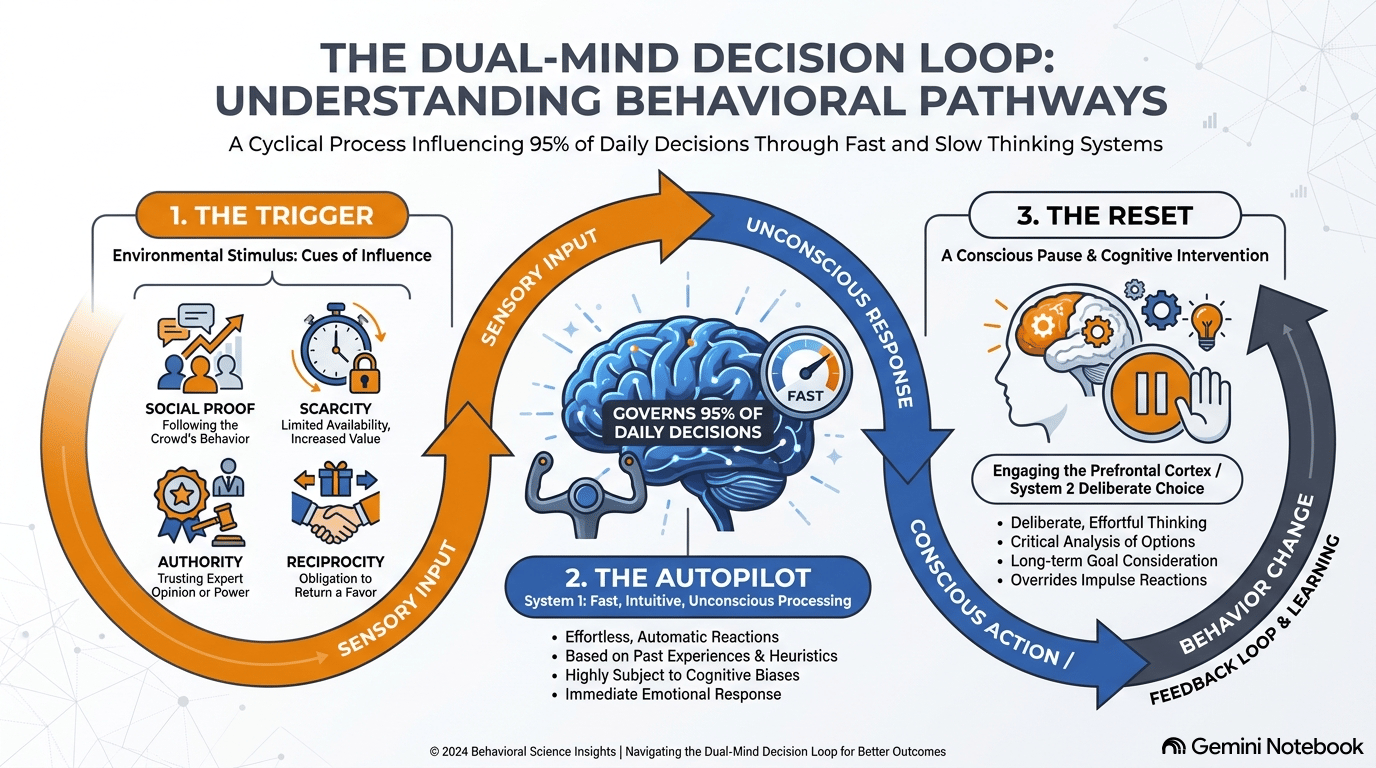
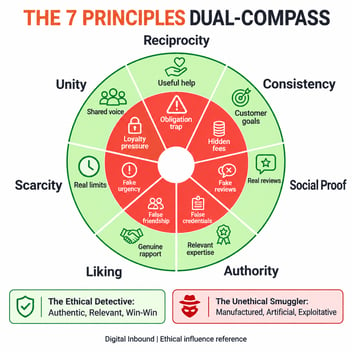
Up to 95% of our daily choices are made automatically by our intuitive System 1 mind (the amygdala and associative memory). Whether you are scrolling through a social feed or evaluating a B2B vendor, the algorithms of digital platforms are engineered around the exact persuasion levers identified by Dr. Robert Cialdini like these four:
- Social Proof: Following the herd to resolve uncertainty.
- Scarcity: Reacting to fear of missing out (FOMO).
- Authority: Reflexively deferring to credentials or emblems.
- Reciprocity: The instinct to repay unsolicited favors.
When you learn to identify these triggers in real time, you interrupt the unconscious programming, engage your prefrontal cortex (System 2), and make deliberate, rational choices.
For consumers, this is how you reclaim your cognitive sovereignty.
For agency leaders and marketers, this is how you practice ethical influence: not by deploying deceptive tricks, but by helping your audience navigate choices with clarity, relevance, and trust.
Key Takeaways for Business Leaders:
-
Don’t Pay for Content Generation—Pay for Context Architecture: Shift budget away from manual content typing toward deep ICP (Ideal Customer Profile) profiling, competitive positioning, and CRM context curation.
-
Diagnose the Root Pain: Never accept a surface symptom at face value. Ask open-ended questions until you uncover the behavioral friction causing the issue.
-
Teach Your Team to Fish: The goal of a modern agency partnership is mutual empowerment, building systems that make your internal team self-sufficient.
-
Align Marketing with Human Biology: Marketing tools will continue to evolve, but human evolutionary psychology remains constant. Ground your strategy in how the mind actually makes decisions.
I want the thank Hannah Kenerly for inviting me onto her Agency Visionaries podcast. Here are the links you need to see the full podcast and get in touch with Hannah:
Here https://www.linkedin.com/in/hannah-kenerly/
My Episode YouTube post: https://www.youtube.com/watch?v=H0S0xbvlRko
Check out new episodes wherever you listen to your podcasts:
YouTube: https://lnkd.in/eSwVCGmp
Spotify: https://lnkd.in/e98Gx6x7
Apple Podcasts: https://lnkd.in/eQvct4sy